Showing posts with label Overwinter. Show all posts

Monday, April 9, 2012

No Till Gardening

Bellevue gardens,  4/8/2012
      When I started our first home garden in 1975, I did not have a truck or a tiller, and so had to dig the garden by hand.  A lot of work, but it worked fine.  When we moved to Michigan a year later, I had read about the double dig method.  It should read the double the trouble method.  I won't do that again.  We had a garden, but it was a lot of work.  Still though, I had not used a tiller.  When we moved here to Delaware in 1979, the garden was already in, but it was a wet clay, slippery mess where the previous owner had put down  "two by fours" to be able to walk without falling in the clay soup.  Since that time, I have put down wood chips for paths, and ground leaves for mulch.  And more wood chips and more leaves.  And more leaves, and more and still more.  Everything goes on top of the soil.  The only digging I do is to plant seeds or starts.
      A huge benefit can be seen in the above photo.  My garden on the right is fully planted and currently productive.  Most folks are still tilling and now just starting to seed or put in transplants.  The plot on the left has already had a load of mushroom soil tilled in, but that mushroom addition has disappeared as fertilizer for the weeds.  It will get tilled again before being planted.  Then the pathways between rows will be tilled again and again as the method for "weeding" the garden.  All the while grinding up the weeds and grass into more small pieces that will grow again.  You can see the mushroom soil in my garden on the right.  I used it as a mulch on top of the soil, where it will still release its nutrient value, while serving as a valuable mulch to keep down the weeds.  The soil is so friable and moist, that any weeds that do grow are very easy to pull by hand.  In neighboring Pennsylvania where the mushroom soil comes from, the mushroom growers by law have to steam sterilize the mushroom soil before it leaves the mushroom houses.  Thus it makes a great weed free mulch.  Grass clippings, leaves, and wood chips on top of the soil all work as good mulch.
      By setting up permanent beds and paths, only the path areas get walked on.  The soil in the beds stays light and unpacked.  And full of plants year round.


      This shot shows the garden plots on the east side of my plot.  All three kale varieties, Beedy's Camden, Red Russian, and Scotch Curly leaf, overwintered and are producing harvestable leaves even as they are going to flower.  The cut seed heads before flowering are a delicious alternative to broccoli raab.  We had some last night with pasta, sweet peppers, and sweet Italian sausage.  Scrumptious.
      Also in current production are collards and collards flower stalks, Egyptian walking onions eaten as green onions, leeks, overwintered Tango lettuce, and cutting celery.  Lots of different lettuces are still producing in the cold frames, even as new starts are being planted.  And some cardoon is ready to harvest if I only knew what to do with it. 


     Out of nearly two hundred garden plots at the park, mine is the one green oasis among plowed furrows or weed patches yet to be tilled.  With gas at $4/gallon, I don't see any reason to change from my old ways.


Tuesday, April 3, 2012

Park Garden Update, 4/1/2012

      The first of April is here, and already my garden at the park is full to overflowing.  It will be a challenge to be able to find room for the warm weather veggies.  Though in another month, a lot of the cold weather veggies will have had their day, and be ready to be pulled.

Cold frames open, 4/1/2012
Arugula frame
Assorted lettuce and tatsoi

      This cold frame has various lettuce plants that need a good picking.  The cell packs at the bottom have most likely been cut down by slugs.  The pack at the top with the single leaf was a five pack of purchased kohlrabi starts.  I was going to put them in the ground today, but the voles left just this one leaf out of the two packs of five that I had.  The voles are becoming public enemy number one.  The packs along the top are leeks, obviously not a favorite of the voles.  Maybe this garden should be all onions, garlic, and leeks.

Garlic on left, collards, transplanted garlic
Parsnips
Cardoon and garlic starts
Blooming cole volunteer, spinach, Beedy's kale, and Chinese mustard
Harvestable Egyptian walking onions
Fava bean row
Overwintered artichoke
Overwintered arugula and tons of potential garlic
Overwintered red russian kale and leeks
Overwintered Tango lettuce
Still waiting for the podded peas to sprout

Saturday, March 24, 2012

Parsnips and Spinach

Overwintered spinach in center,  3/23/12
      I had almost given up on growing spinach as it seems to be a critter magnet.  Particularly little teeny, tiny sap suckers that you will miss unless looking for them.  This plant in the middle of the above photo has overwintered, and is now putting on a great burst of new, clean spring growth.  Planting spinach in the fall to come back in the spring before the bugs get it, is probably the best way to grow organic spinach that I have found.  But still willing to try to get in a fresh spring crop, I started this America Spinach with the paper towel method:

America Spinach starts,  3/23/12


      The larger plants are a couple of spinach that overwintered.  The smaller ones are the starts just put in yesterday.

Parsnip starts, 3/23/12
      Thirty some years ago in Michigan was the last time that I grew parsnips successfully.  Usually they just don't bother to come up when seeded directly in the ground.  So I started these with the paper towel method and transplanted them just after germination to cell packs.  The garden pros do not suggest starting root crops to transplant, as it may deform the root.  Hopefully these little guys are not aware of that rule.


      I put the top row in a couple of days ago, and was so happy with the way they took, that I added more along the bottom.  Quite a few more were put in the bed over by the cardoon.  I am hoping for some big fat roots this fall to store over winter to add to soups or a medley of baked root crops.

Thursday, March 22, 2012

Fava Beans and English Podded Peas

      The nice thing about having a blog site is that it so easily allows me to mix photos and text to keep track of my own gardening progress.  So next year I will be able to go back to today's blog and see that I could probably have planted fava beans and peas a bit earlier.  Fava beans are not your usual bush bean, and can take quite a bit of cold.  I am still learning about favas, including the need to seek out great recipes.  Favas are also known as broad beans.

Fava Bean Starts,  3/21/2012


   The plot size at the park is 20 ft by 40 feet.  Gardens are laid out in two plot parcels, so there is a path on three sides of my plot, while the left border abuts my neighbor's garden.  He tills his garden, but can't get right next to my permanent stakes.  Thus a weedy strip grows between the gardens, which means that the weeds ultimately send raiding parties into my plot.  So about a week ago, I dug out the weeds, and mounded up the border with mushroom soil.  And since I have very little open space in which to plant, this seemed the perfect place to plant the fava bean starts.


      I do not always follow the companion planting theory, but I read repeatedly that peas and beans DO NOT LIKE growing with the members of the allium family such as onions and garlic.  That tenet I do respect, so it limits where I can put peas and beans in this plot since there are so many onions and garlic.  This picture shows the cleaned up border area, with the fava beans planted at the top part of the bed, away from the garlic row at the bottom.  While digging out the weeds, I came upon many nice grass clumps.  They were headed for the compost pile, but I put them in the truck instead.  They will be used to patch some bare areas in the lawn at home.  Wish I had many more clumps.


      Here you can see the beans a little more clearly.  They are planted directly in the mushroom soil, so I hope that will not be a problem.  The fava bean plants get to be a bush, easily two to three feet high.  The aphids certainly like fava foliage and stems, but don't seem to be a big problem, as the volunteer ladybugs soon find the bed a great place to find tasty tidbits.


      Ah, another spot not close to onions.  This bed is for the english podded peas, name unknown as I had not labeled the bag of bulk seeds.  Years ago I had sworn off growing podded peas, as they take a lot of space to get a worthwhile harvest.  But I planted some two years ago to use up some seed, and they were sooo delicious when eaten raw like peanuts, that I was a convert.  I will still plant some snap peas and snow peas, but the podded peas are worth some space.

English Podded Peas,  3/21/2012
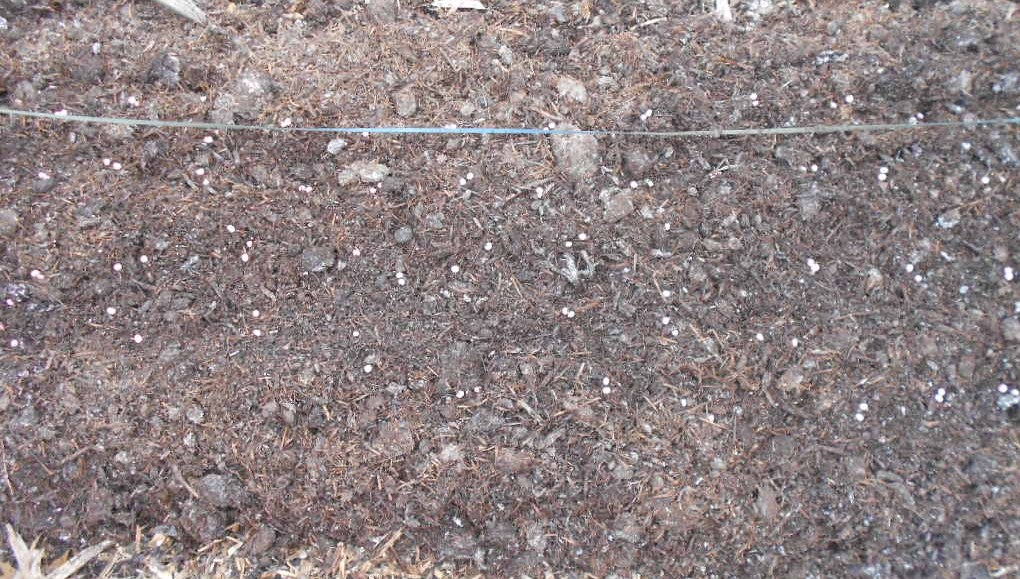
      In this picture, you can see the peas on the bed.  I tried to drop two peas at about five inch spacing.  Then I went along with a long pole to push them into the bed, thus not having to bend over or plant from a kneeling position.  I am sure the peas didn't care that I avoided a sore back.  Hope they don't mind getting started in the straight mushroom soil top dressing.
      These last two pictures were taken yesterday just for archive purposes:


      The plants above are Tango Lettuce that overwintered without any protection.  Where they were crowded, I dug out a plant or two and replanted them with more leg room.  Yep, then added more mushroom soil as a side dressing.


      This is a shot of one of the cold frames showing lettuce and tatsoi.  Those few empty spots were filled in yesterday with new lettuce starts.  And mushroom soil for good measure.

Tuesday, March 20, 2012

Plant Rescue 103B - Onions

Overwintered onions,  3/19/2012
      My post about onions on March 14th did not contain pictures about cleaning up the onions that overwintered.  There were bulbs from the porch that had started to sprout, and bulbs from both gardens that are starting to regrow.  When they regrow, they send up multiple new plants which should be separated and replanted.  I hope the new shoots make good bulbs, or this activity is a waste of time.  In this picture above, you can see the new growth starting on two of these onions.  I have already started to peel the shiny one.


      Layer after layer needs to be peeled back until you get to individual plantlets.  This onion is nice because it is still mostly firm.  Some in the ground can be pretty mushy and yucky, thus a mess to tear apart.

Onions to replant, 3/19/2012
      Those two onions resulted in this total of eight stems to replant.  I have not found any literature on this topic of regrowth.  Will the newly planted onions think they are two years old, and thus try to go to seed before they form bulbs?  Any thoughts here?

Monday, March 19, 2012

Blooming Arugula

Park Garden Arugula,  3/17/2012
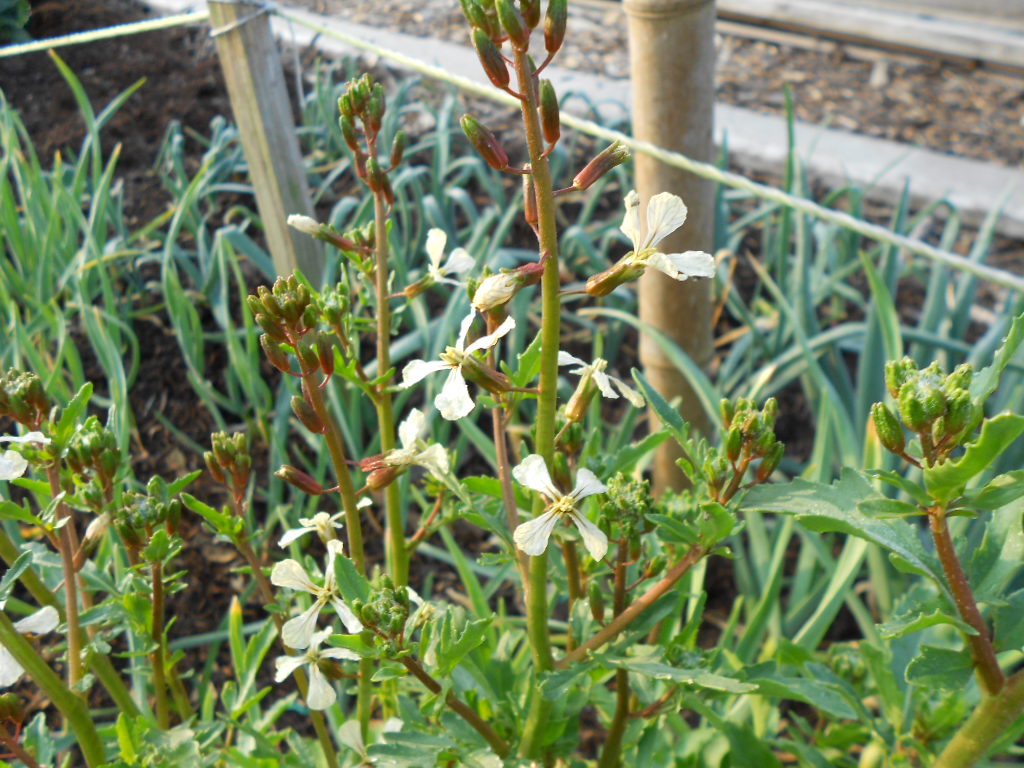
      This arugula plant has overwintered in an open bed at my park garden.  It has a big earthy taste with a nice bite, to me that spells wonderful arugula.  It is now in full bloom, which hopefully means that I can save some seed for a new fall crop to overwinter.  In the meantime, I will still snitch some leaves and flowers to liven up a salad.


Friday, March 2, 2012

Park Garden Update, 3/1/2012

Arugula overwintered without protection,  3/1/2012
      With it being the first of March, I have a feeling that the worst of winter has to be behind us.  We should have seen the coldest temperatures of the season already.  So hopefully anything that has overwintered so far will make it.  The arugula in the photo above has done well, and it is putting up seed heads.  I want to harvest those seeds, as this plant is obviously quite hardy, and also has a powerfully good taste as well.

Cold frame arugula,  3/1/2012
Garlic and collards,  3/1/2012
Cardoon and baby garlic sprouts in cold frame,  3/1/2012
Overwintered celery and garlic
      These garlic plants are from small cloves that I planted two years ago.  I lost track of them last year, and did not pull the plants when I could see them in June.  They either died back or were just ignored, but now they are doing quite well.  The plants are in clumps of six to eight stalks, where the smaller bulbs from the year before had divided.  So now I have to dig up the clumps and separate them, then replant individual plants on 5 to 6 inch centers.  If I leave them crowded, I will get a bunch of small cloves.

Compost pile volunteers,  3/1/2012
Unprotected Tango lettuce,  3/1/2012
Various cold frame greens,  3/1/2012
Spinach starts under glass,  3/1/2012

Saturday, February 18, 2012

Hardy Greens

      It certainly has been a mild winter so far.  Our low temperature locally has been 13 degrees, with a couple of 15 degree mornings also thrown in.  And those cold temperatures did not come in a long stretch, rather as interspersed single day cold snaps.  Here we are more than half way through February, so hopefully the coldest lows are behind us.  Many different cold hardy greens have not only survived, but are harvestable.

Mild mustard, 2/18/2012
      This mustard plant is growing right at the base of the compost pile.  Not only does it get a little wind break, it gets some good nutrients from the compost.

Similar mustard, completely unprotected,  2/18/2012

      These three plants are all volunteers.  The one on the left is another mustard, the one on the right looks like bak choi, and the one at the top is probably senposai, which is a hybrid of cabbage and Komatsuna.  Just don't ask me what Komatsuna is.


Also senposai?
      I harvested leaves from the mustard, the bak choi, and the senposai.  My thought is to shred all three and add some carrot shavings and onions to make a winter cole slaw.  Wish me luck.