Showing posts with label Cardoon. Show all posts

Friday, March 2, 2012

Park Garden Update, 3/1/2012

Arugula overwintered without protection,  3/1/2012
      With it being the first of March, I have a feeling that the worst of winter has to be behind us.  We should have seen the coldest temperatures of the season already.  So hopefully anything that has overwintered so far will make it.  The arugula in the photo above has done well, and it is putting up seed heads.  I want to harvest those seeds, as this plant is obviously quite hardy, and also has a powerfully good taste as well.

Cold frame arugula,  3/1/2012
Garlic and collards,  3/1/2012
Cardoon and baby garlic sprouts in cold frame,  3/1/2012
Overwintered celery and garlic
      These garlic plants are from small cloves that I planted two years ago.  I lost track of them last year, and did not pull the plants when I could see them in June.  They either died back or were just ignored, but now they are doing quite well.  The plants are in clumps of six to eight stalks, where the smaller bulbs from the year before had divided.  So now I have to dig up the clumps and separate them, then replant individual plants on 5 to 6 inch centers.  If I leave them crowded, I will get a bunch of small cloves.

Compost pile volunteers,  3/1/2012
Unprotected Tango lettuce,  3/1/2012
Various cold frame greens,  3/1/2012
Spinach starts under glass,  3/1/2012

Sunday, January 1, 2012

Park Garden, 1/1/2012

      Now over to the park for the first of the year update.  Cold hardy greens such as kale and collards are doing well in many gardens.  On to my garden:

My collards, ready for a picking

Open space from harvest of savoy cabbage yesterday
Cardoon, 1/1/2012
      This cold frame, with the regrowing stumps of cardoon, has received a thin layer of mushroom soil to cover the garlic bulblets from an earlier post.  I saw three little shoots of garlic, including the one in the left corner of the following photo:

Garlic shoot, midway between post and cardoon plant

      This bed has seen better days.  The deer and voles have cleaned out all of the beets that were in the middle.  The voles and George have decimated the radishes.  I will sorely miss that crop.  The Beedy's Camden kale over near the right side is doing well, having been harvested heavily yesterday.  Finally, the thick stem chinese mustard on the far right is doing really well, and needs a heavy picking.

Artichokes, 1/1/12
      These two artichoke plants are doing great, having survived a couple of 23 degree mornings so far.  I might cover them somehow tomorrow if i get really motivated.  Or maybe dig them up to over winter on the relatively cozy porch.


      Many of the egyptian walking onions above are yellowing a bit.  I suppose that has to do with the cooler temperatures, though they should do fine if left alone.  They will recover quickly in the spring.


      This arugula plant is still growing nicely in this cold weather, allowing for some limited harvesting.  The garlic plants on both sides are also growing slowly.  Right now you want root growth in garlic rather than stem growth.  I hope to mulch this bed soon with a couple of inches of leaf mold.

Veggies in unprotected bed, 1/1/2012
Ah, arugula - 1/1/2012

Cold frame packed tight, 1/1/2012

Leeks on left, Rainbow Lacinto kale, and blue curly scotch kale

Thursday, November 3, 2011

Halloween Resurrection

      Ghosts and goblins were not the only things to find a new life on Halloween.  Many of my charges who looked so poorly after the Mischief Night frost made miraculous recoveries.  Some such as the nasturtium, did not rise again.

Nasturtium, there is always next year

      But on to some of the snap backs, the little planter of lettuce looks much better,


      And the Tango lettuce has recovered to fight another day.  It certainly looked bad just yesterday morning.


      The cardoon pictured below also bounced back.  Still presenting me the problem of what to do with it.  I did bring a stem home yesterday to try to figure some way to cook it.  Still figuring.


      The bed of greens next to the cardoon look fine.  They should not have looked so bad after the frost.  Maybe they will acclimate to the weather as we have more frequent frosts.


      The beds that I had protected with glass look great.  There are spots where leaves are burned that touched the glass and froze.  I am working now to make the cold frames taller and sturdier.  It is turning out to be a project.


      And lastly, remember the chinese cabbage?  The one I look at longingly every day?  Well, I am still looking at it longingly, as it still looks marvelous.  Will be simply scrumptious.  Unless the deer.....

Wednesday, November 2, 2011

Mischief Night

      There was a time in the past when mischief night, the night before Halloween, was possibly a scary evening.  On a couple of different occasions on the mornings following that night, our trees and lawn were full of toilet paper trails.  Not too bad on the damage scale, but when it gets wet, it is a sticky mess.  Well after our girls graduated college, got married, and moved out, their friends, ha, quit visiting us on mischief night.
      So on this Halloween morning I was not expecting to see any evidence of mischief night.  But alas, I was wrong.  Somebody visited my gardens and laid them to waste.  Knocked over plants, left ice crystals in their wake.  Mother Nature had visited with her first hard frost of the season.  The day after the nor'easter.  When the cold air backed in.  I had covered some beds with glass, but other areas suffered.
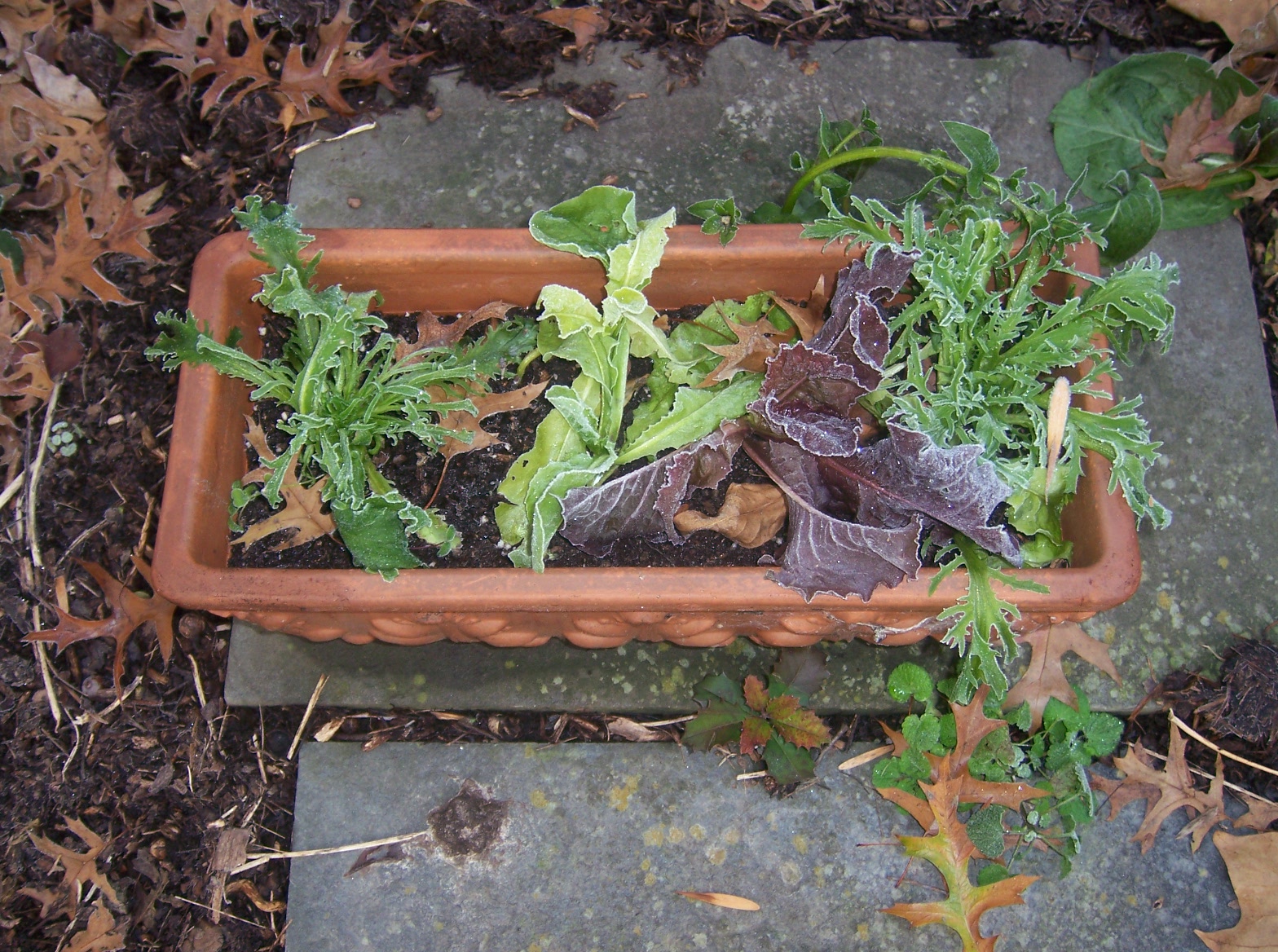

      The walk to the back garden revealed grass blades covered in frost.  My terra cotta pot below with a beautiful mix of lettuce textures and colors wasn't so beautiful as a droopy mess.


      The canna lily clump above sure didn't like the frost.  The easiest way to deal with the cannas at the end of the season is to cut them down with a knife, load them on the pick up truck, and take them on a vacation trip to the yard waste center.  Trying to shred or chop the cannas at home to compost them is a waste of time.


      Even the swiss chard took a hit.  I was hoping to get another meal out of this patch before winter.


      Over at the park, there was serious ice on the emergency cold frames.  In many places, the veggies were frozen to the underside of the glass.  I need to make the cold frames permanent, with a front wall of at least six inches.  Yeah, we know that is going to happen soon.


      Spinach, thick stem chinese mustard, and Beedy's kale, all looked quite the worse for the frost.  And all of those plants are supposed to be relatively cold hardy!


      The cardoon didn't look happy.  This is my first year growing it, so I really didn't know what to expect.  Still have not figured out how to eat it.


      My poor little Tango lettuce patch.  All the leaves with a rim of ice.


      Ditto for the kale above.  And the leeks below.  Not a good visit so far.


      And my longing for this beautiful head to be of chinese cabbage may be dashed not by a hungry deer, but by a killer frost.


      But if Mother Nature was going to be cruel to the plants, she at least presented me with a couple of her Frostwork art pieces that morning, above and below.


Sunday, October 30, 2011

After the Nor'easter

      We dodged another hyped storm here in Wilmington.  A very good thing in my estimation.  Areas in Maryland and Pennsylvania got over two feet, and there are massive power outages caused by fully leaved trees being toppled due to the heavy sticky snow.  We got maybe an inch in places, but I still wondered what may have happened to my gardens.  After breakfast, I headed out back.


      Above is the recently constructed cold frame cozily covered by a layer of snow.  I just planted some of this frame a week ago, and it contains some flats of veggie starts not yet in the ground.  The snow should melt off, as we are expecting a high of 50 today.


      This a cold frame with various lettuces.  It will be ready for harvesting in a few days.


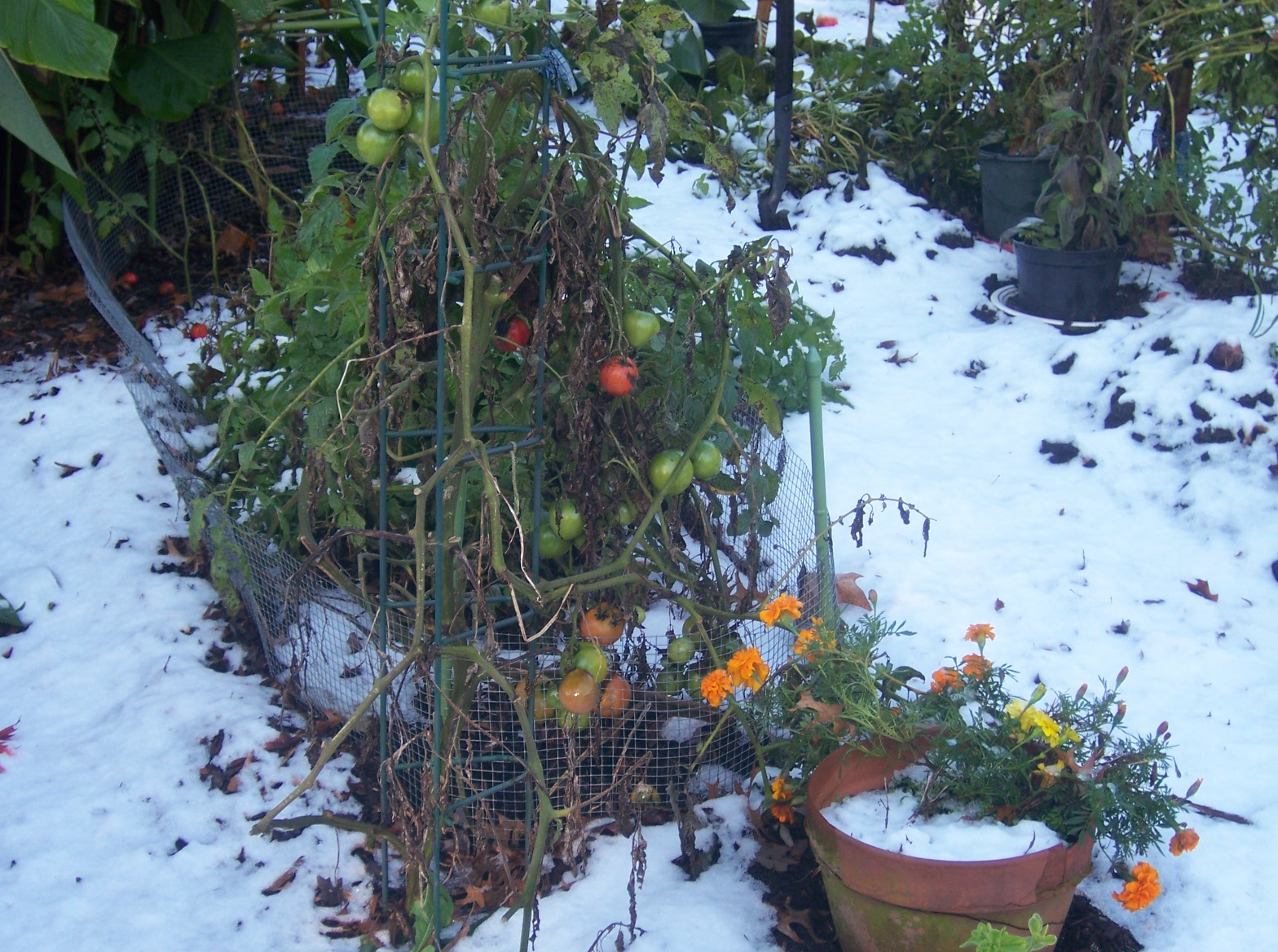
      Here are some tomatoes that I might pick today.  Daughter Emily has a recipe for green tomatoes that she likes.  Maybe this is the opportune time to try it.


      The trip over to the park revealed beds in pretty good shape.  Shown above are two stacks of glass panels that I coulda, woulda, shoulda have put down two days ago before the storm.  Duh.  And yet I thought that the forecast low of 32 degrees would not hurt any of these fall crops, and I was right.  Lucky, as it would have been a really big dumb moment to find a scene of mass destruction this morning.


      The cardoon on the right survived much better than I had expected.  I was prepared to see the plants totally broken and knocked over.  Only a leaf or two were broken.  I have still to get the inspiration to cut the cardoon and cook it.  Any suggestions appreciated.
      The nasturtium in the background was quite a pleasant surprise.  It is very frost sensitive and goes to mush when iced.  I better pick it today or find a way to cover it as tonight is supposed to be sub freezing.  The onions on the left are Egyptian walking onions.  They are eaten as green onions or scallions, and are just now ready for picking.  Emily, do you see those yummies?


      On the left above is a patch of arugula, and on the right the patch of tatsoi.  Both are pretty cold tolerant, and neither seemed to suffer at all.  Both could use some thinning of plants to move to other cold frames.  Any interest out there?


      Above are mixed greens, lettuces, garlic, and more arugula.  Everybody quite happy after the storm.  All should survive temperatures above 28 degrees.


      A closer look at the nasturtium, with an artichoke nestled in.


      A closer shot of the cardoon.  Cardoon and artichokes are closely related, both being in the thistle family.


      The chinese cabbage is looking better and better.  I pray thet some deer doesn't think so too.


      Nasturtium, artichoke, black seeded simpson and a red lettuce all happily crowded together with a dusting of snow.


       And to say goodbye for the moment, a second generation volunteer sunflower for the season.  This plant sprouted from seed dropped from a volunteer early in the summer.  This is the first bloom, and maybe the last.  Perhaps this plant should have waited until next year to sprout.  But yet a pleasant way to start a snowy morning