 |
| How did she braid them like that? |
Showing posts with label Carrots. Show all posts
Showing posts with label Carrots. Show all posts
Friday, September 7, 2012
Happily Twisted
Yes Eileen, I still have the picture of your happily twisted carrots. The photo has been hiding on the camera, but I found it this morning. This picture was taken June 7, 2012, long before the summer got hot and muggy, then hotter and hotter still. Good carrot weather should be right around the corner, but alas, it has been too hot to have started them.


Wednesday, May 4, 2011
No Till Gardening
When we moved into our current home, there was a vegetable garden already in the back yard. The problem was that the previous owner was a chemical oriented gardener, and there was literally no organic matter in a slick clay slop. It was October, and it must have been wet that fall, so the whole garden was a slippery, slick mess. Lengths of 2 x 4s were scattered about the garden to provide safe places to walk. I started adding wood chips and leaves that very first year. Not having a roto tiller and not wanting to spend the money for one, I must have become a no till gardener by accident, long before the method was as popular as it is today. So in the 32 years that we have been here, my garden has never been tilled. I remember trying the double dig method for maybe 1/2 an hour, before figuring out that method is really a lot of work. Let the worms do it, they love it.
No till gardening has lots of benefits, not the least of which is the appearance of a bunch of volunteer seedlings. Unlike most gardeners who rip out older ready to seed veggies, I encourage them to grow on to produce their seed.
Many things are in seed quite early because they overwintered in the cold frames. All the better as I will have fresh seed and volunteers for the fall season. The white flowering plants are arugula, the yellow are various cole crops like mustards, kale, and collards. For some reason, the cole crops for me are breeding true, rather than crossing willy nilly as suggested by the literature. The lettuce, spinach and chicories are soon to bolt and put up seed stalks.
The plant on the left is a very mild tasting mustard that overwintered under some leaf protection. I am going to save that seed for its winter hardiness. The plants in the middle are Beedy's Kale. I like this variety, and the seed crop failed at Fedco last year, so I will be happy to have my own supply.
By not tilling, seeds from garden plants have a better job of coming up naturally in both the beds and the paths. Path volunteers need transplanting to better areas. Mulch can not be added in deep quantities at inopportune times, as that would kill the seedlings as it does the weeds. The weed problem is far less with no tilling, as weed seeds are not continually tilled back to the surface. On to the volunteers:
On the far left is baby Lamb's Quarter, a dreaded weed to many, but quite edible and delicious when young and tender. It has a very nice nutty flavor, and the deep taproot draws nutrients from deep in the soil to be added to the compost pile. I actually transplanted some to the garden last year, but it is now freely self seeding. To the right of it is a small celery plant, really not needed as I have millions in their own patch. The plant that looks like a little carrot is actually going to be a cosmos. As I have not started my seeds at home yet, it thrills me to be finding numerous cosmos coming up on their own.
Nestled in among the overwintered onions are several volunteer lettuce babies and some red russian kale. Carrot seed from my own collected carrot tops was broadcast amongst the onions in the fall. Lots of carrots the size of my pinkie strongly hint it might be my most successful carrot year ever (pretty easy thing to accomplish).
More beautiful volunteer red lettuce, with feathery volunteer chamomile below it on the right. To the left is a corner of the volunteer celery patch.
Fellow gardener John V gave me a couple of celery plants last year. True to form, I let them flower and seed. Now I have millions of celery volunteers, others significantly larger than these. I hope to get my first edible celery this year from these naturalized plants. Home grown celery can be very strong flavored, more usable for soup stock than eating raw. I have not tried the blanching routine yet, maybe this will be the first year.
The baby tomato volunteers are just now starting to sprout. Maybe that is an indication that the starts can go in the ground?
No till gardening has lots of benefits, not the least of which is the appearance of a bunch of volunteer seedlings. Unlike most gardeners who rip out older ready to seed veggies, I encourage them to grow on to produce their seed.
 |
| Bellevue, 5-3-11 |
Many things are in seed quite early because they overwintered in the cold frames. All the better as I will have fresh seed and volunteers for the fall season. The white flowering plants are arugula, the yellow are various cole crops like mustards, kale, and collards. For some reason, the cole crops for me are breeding true, rather than crossing willy nilly as suggested by the literature. The lettuce, spinach and chicories are soon to bolt and put up seed stalks.
 |
| Bellevue, 5-3-11 |
The plant on the left is a very mild tasting mustard that overwintered under some leaf protection. I am going to save that seed for its winter hardiness. The plants in the middle are Beedy's Kale. I like this variety, and the seed crop failed at Fedco last year, so I will be happy to have my own supply.
By not tilling, seeds from garden plants have a better job of coming up naturally in both the beds and the paths. Path volunteers need transplanting to better areas. Mulch can not be added in deep quantities at inopportune times, as that would kill the seedlings as it does the weeds. The weed problem is far less with no tilling, as weed seeds are not continually tilled back to the surface. On to the volunteers:
 |
| Sunflower to be, 5-3-11 |
 |
| Bellevue, 5-3-11 |
On the far left is baby Lamb's Quarter, a dreaded weed to many, but quite edible and delicious when young and tender. It has a very nice nutty flavor, and the deep taproot draws nutrients from deep in the soil to be added to the compost pile. I actually transplanted some to the garden last year, but it is now freely self seeding. To the right of it is a small celery plant, really not needed as I have millions in their own patch. The plant that looks like a little carrot is actually going to be a cosmos. As I have not started my seeds at home yet, it thrills me to be finding numerous cosmos coming up on their own.
 |
| Red Sails Lettuce and Sunflower, 5-3-11 |
 |
| Even more Sunflowers, 5-3-11 |
 |
| Bellevue, 5-3-11 |
Nestled in among the overwintered onions are several volunteer lettuce babies and some red russian kale. Carrot seed from my own collected carrot tops was broadcast amongst the onions in the fall. Lots of carrots the size of my pinkie strongly hint it might be my most successful carrot year ever (pretty easy thing to accomplish).
 |
| Bellevue, 5-3-11 |
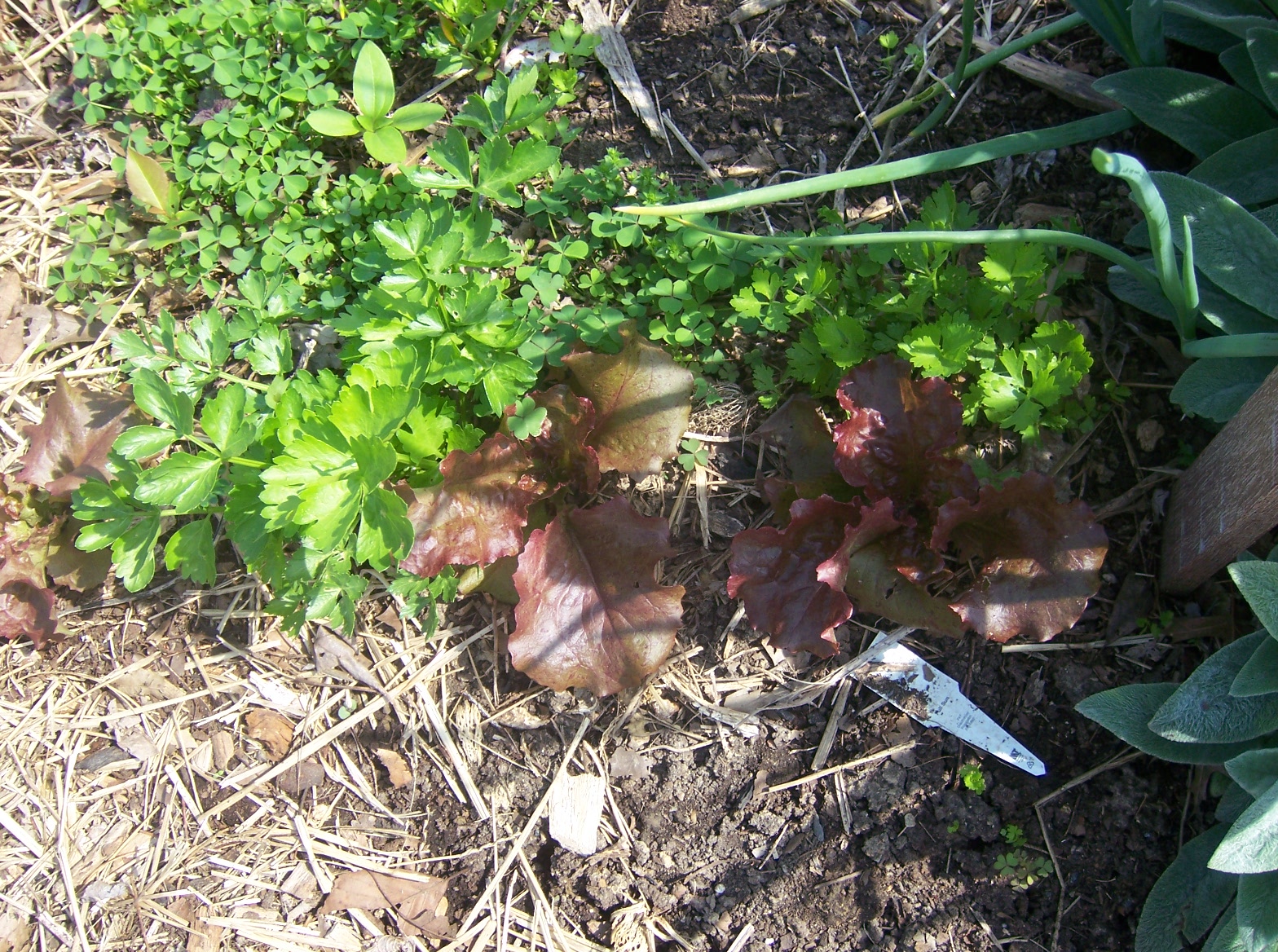
More beautiful volunteer red lettuce, with feathery volunteer chamomile below it on the right. To the left is a corner of the volunteer celery patch.
 |
| More lettuce, celery, and a sunflower, 3-3-11 |
 |
| Celery, celery, and more celery, 5-3-11 |
Fellow gardener John V gave me a couple of celery plants last year. True to form, I let them flower and seed. Now I have millions of celery volunteers, others significantly larger than these. I hope to get my first edible celery this year from these naturalized plants. Home grown celery can be very strong flavored, more usable for soup stock than eating raw. I have not tried the blanching routine yet, maybe this will be the first year.
The baby tomato volunteers are just now starting to sprout. Maybe that is an indication that the starts can go in the ground?
Saturday, April 23, 2011
Mustard anyone?
 |
| Mustard greens, 4/22/11 |
We often times try so hard to grow things in our gardens. Buy things and they will die. Plant seeds and they don't germinate. Or the bunnies or the birds eat the new starts. Other times we do nothing and are over run by volunteers. These light green plants are Florida Broadleaf Mustard that are coming up where I had mustard in a cold frame TWO years ago. Go figure. The darker green leafed plants are Purple coneflowers, and these too would not be so successful had I tried to grow them. So if you could use either, give me a holler and come on over for a dig.
Planting notes: On 4/20, I planted two short rows of Chioggia beets in the seed bed just to the west of the box cold frame in the Bellevue garden. Just to the left of those rows were two rows of Fedco White Satin carrots. Those carrots did well last year and were delicious. In the middle of the seed bed was a row of salsify, Tragopogon porrifolius, a first time try for me. Say that name fast. Heck, try to say it slowly.
I finally planted a border row of Purple Top White Turnips along the south edge of bed number three. Hopefully they will grow quickly and be able to be pulled. I broadcast multiple tablespoons of home grown and harvested carrot seed along the north side of bed number two. The carrots seeded the same way in the onion bed are coming along nicely. When I pulled a clump of weed grass out last week, three small carrots pulled out as well. The largest was about the size of my little finger. I made three holes in another area of the bed and stuck them back in. The tops are recovering now after a couple of days of wilting.
After having very poor germination with some nasturtium and zinnia seeds, I tried a different tack last night. I had received a seed sprouting kit as a present, which does a great job for sprouting veggie seeds to eat. So both of the above mentioned flowers now have a tray apiece. If the seeds sprout, I plan on transferring them to dirt before they leaf out. At least I can keep an eye on their development. Will update with a progress report.
Subscribe to:
Posts (Atom)