Showing posts with label Savoy Cabbage. Show all posts

Sunday, June 23, 2013

Savoy Cabbage Harvest

      Some critter, probably a rabbit, had snipped off one of my four Savoy Cabbage starts that I had put in my park garden in the spring.  The plant tried to make a comeback, but the head was going to be quite small. Yesterday I noticed that some critter had eaten half of that small head (probably a vole), so it was time to harvest the good heads before they got chomped.

Isn't she pretty?
The other two good heads
I will grow Savoy Cabbage again
Red Cabbage still needs more time

      Here are the three heads of the Savoy, one of which was sliced in half.  We ran the one half through the food shredder along with a complete smallish head of regular green cabbage.  Added carrots sliced and my own Walla Walla onions diced.  Cindy made a vinaigrette dressing with some of our fresh parsley, then it was into the fridge for a few hours to cool and mix.  With some pork chops and buttered boiled potatoes, it made for a fine summer dinner.

Tuesday, June 18, 2013

Cabbage Looking Good

      I had planted four cabbage plants in a bed, then surrounded them with onion starts.  Wondering if the onions might ward off evil spirits and cabbage moths.  One of the cabbage had his top eaten open, probably from voles.  Another one had some rot, so it got tossed into the compost pile.  The other two were somewhat passable as food, but as I peeled off leaf after leaf, I continued to find pill bugs, centipedes, and even earthworms.  Finally got down to two decent cores which I put in a tight bag into the fridge.
      The Savoy cabbage and red cabbage that are still in the ground are much more attractive, and have little apparent bug damage.  Maybe the answer is to grow the weird cabbage.  These are totally organic, with no pesticides or even fertilizers used. 

Savoy Cabbage, June 18th,  2013
Red Cabbage
      Now what do I do with the cabbage?  If somebody has a cherished recipe for coleslaw or any other preparation of cabbage, I would love to try it.

Saturday, December 31, 2011

Last Harvest of 2011

      This morning I had my last harvest of the year over at the park garden.  It was the last harvest only because the year gave out on the garden, the garden did not give up for the year.  Should I choose to, I can make tomorrow the first harvest of 2012.  That is pretty much a done deal with the temperature forecast to be in the 50's.  A pleasant start to the year, followed by a predicted low of 18 degrees on Tuesday.  That should pretty much wipe out all but the hardiest non protected veggies, that being collards, kale and leeks.

Last Harvest of 2011
      On the bottom left is blue curled scotch kale, with Beedy's Camden kale on the right.  At the top is a savoy cabbage I picked today simply to grab it before the deer or the voles got it.  It will store very well in the fridge for awhile.  Both kales are already chopped and added to the pot along with olive oil, onions and garlic.  The beginnings of delicious kale and white bean soup.  Simply scrumptious.

Saute first, soup next, 12/31/11

Friday, December 16, 2011

Park Garden, 12/15/11

      This is the bunch of pictures for the park garden update.  I have not checked them for growth against the December 1st photos, but the park is in full sun, so I should compare.


       The collards are on the left, and should survive pretty much any weather we get over the winter.  The savoy cabbage to the right is also supposedly quite cold hardy.  If the hose at the top would grow just a few more feet over the winter, it would be a perfect length.  Actually garlic plants are to the left of the collards.  They should do fine over the winter with a little leaf mulch.


       The shot above is of the cold frame with the cardoon recovering after being hacked to the ground by voles.  The discolored leaves in the middle are where the plant touched the glass and froze.  The little popcorn thingies are the garlic bulblets.  Some are just starting to root, and all are changing to a lighter color.  A one inch layer of mushroom soil certainly would not hurt.


      From left to right are pak choi, radishes, beets, Beedy's Camden kale, and thick stemmed chinese mustard.  I suspect that the radishes and beets are being chomped on by the voles.


      These two frilly plants are artichokes.  They did not produce in their first year, and I am torn between digging them up for winter protection or trying to protect them somehow in the garden.  If protected, the voles would think they were a Christmas present.  There are two nice frisees and an oriental green that could be moved to a cold frame.


       This is the stand of Egyptian walking onions.  These are ready for thinning and eating, but watch out, these babies are potent.

      
       On the other side of the onions are one volunteer arugula plant surrounded by newly sprouted garlic.  The garlic cloves were of decent size, so I am hoping for an edible harvest from this bed.


       These little green pop ups are French shallots from last year that were just a tad too small to fool with for cooking.  They should yield edible bulbs next year, as well as provide some bulbs to plant in the fall.


       This shot is of the base of the compost pile, where lots of volunteers get started.  The light green leaves just left of center are escarole plants, and to the right of them is a nice cole crop volunteer.


       This bed of tatsoi has done extremely well.  I only wish that I had thinned it even more to let the rosettes get a little larger.  I have moved quite a bit to cold frames, but it should survive the winter on its own.


       More volunteers.  Some darker leaved lettuces on the left interspersed among the small baby celery starts.  More oriental greens, and mizuna mustard and garlic off to the right.


       Celery to the left, garlic in the middle, and mixed greens and lettuce to the right.


       The "New Supply" of lettuces still to be planted.   Since things don't seem to be growing much anymore, I may actually dig up the rest of the lettuce plants from the neighbor's garden.


       Leeks and kale growing in the bed at the top of the picture.  Lots of various greens and lettuces in the cold frame.


      Mixed oriental greens at the bottom of this shot.  Much vole damage at the top.


Mostly celery


       Various green volunteer lettuce plants to the left.  A lush carpet of chick weed in the middle with some dark lettuce tucked in, and the leeks to the right.

 
Radishes on left, mixed lettuce on right
 
Fall planted onions starting to sprout

Beautiful cold frame lettuce

Ah, that arugula
 
All volunteer cole plants
 
A cold frame with room to transplant!
 
Pak Choi still in bloom brings in lots of bees

Thursday, December 8, 2011

Season Extending Greens

      One of my favorite seed catalog companies is Fedco Seeds, based in Waterville, Maine.  They have a lot of seed appropriate for their cold winters, so I believe some of those plants should bask in delight in the relative warmth of my zone 7A gardens.  While I have been doing a lot of experimenting with cold frames, much of their stuff should overwinter unprotected.  I could not figure out how to copy and paste from their internet delivered pdf catalog,
http://www.fedcoseeds.com,

so I took this picture from page 53 of my hard copy catalog.

From Fedco Seeds 2011 Catalog
      I have tried all of the spinaches, without much success.  They grow, but then get these tiny little pin head sized bugs that probably suck the sap.  Yet I continue to try spinach, and realize I have none planted inside the cold frames.  I should try, as maybe the little bugs won't like winter.
      The lettuce varieties I have from this list are the Tango and the Rouge d'Hiver.  Love them both, and the Tango did overwinter unprotected last year!  Anyone want to go together to buy and share some of the other lettuce varieties on the list?  Fedco has free shipping for orders over $30.00.  Can't beat that.


      I have Rainbow Lacinato kale, curly leaf kale, and Beedy's Camden kale currently in the park garden.

Beedy's Kale at top, Thick Stem Chinese Mustard at bottom, 12/8/11

Rainbow Lacinto kale on left, curly kale on right, 12/8/11

Tatsoi, 12/8/11
      The tatsoi has been a huge success.  This block of tatsoi germinated very well, and I have been thinning it to move to my cold frames, Barb's cold frames, gardeners at the park, and anyone else willing to take some.  It overwintered for me unprotected last year, and I have read numerous reports of people harvesting tatsoi from underneath a snow or ice cover.

Collards, unknown variety, 12/8/11

Savoy cabbage, unknown variety, 12/8/11
      I tried two varieties of parsley this year, but ended up feeding the bugs.  Claytonia has self seeded in one of the cold frames, and has come on to a nice rebirth in the cooler weather.  Only enough though to graze once and awhile when at the park.

Right side of back yard cold frame, 12/8/11
      The minutina is in the bottom right corner of this shot.  It is reputed to be quite cold tolerant, so probably does not to be in the cold frame.  The lettuce directly above the minutina is Winter Marvel Bibb lettuce, the only head lettuce that I am growing.  That one nice looking head may be a self Christmas present.  The tatsoi is on the bottom left, and really has done well from the transplanting and thinning.  Pak choi is in the top right corner, and although a good candidate for a fall garden, it apparently can't take the winter cold.

Left side of back yard cold frame, 12/8/11
      Some of the thick stemmed chinese mustard appears at the top next to the pak choi.  Also on the cold hardy list is arugula, the two plants at the bottom left corner.  Some of these folks from the back yard cold frame may be invited for dinner tonight.

Wednesday, December 7, 2011

Cloning Update

      I discovered a couple of things this morning.  One, the reason that my close up pictures are blurred is not because of the flash, but because there is a setting on the little camera to take pictures of a subject that is closer than 28 inches.  Duh.  Unfortunately the next two shots were taken before that momentous discovery.

Savoy cabbage, 12/4/11
Savoy cabbage, 12/7/11

      Look how that little guy has grown!  That poor abused plant is going to be a survivor.  Luckily I had planted the stalk in a plastic container, and upon close inspection, I could see leaves against the container below the soil level.  So I dug up the stalk to replant it more vertically.  And discovered six more little cabbages starting to grow!

Savoy cabbage, 12/7/11

      All the little leaves on the bottom half of the picture were under the dirt.  Now they will have a chance at some light.  When they get a little bit bigger, I will cut them off the stalk to try to root them individually.
      I have found very little information about rooting radish parts on the web.

Radish to prep, 12/6/11

Radish cut for rooting, 12/6/11

      What I did find says that the portion on the left will not reroot and grow a new radish.  I am planting some of those pieces anyway, as those pieces look like prime candidates to me.  The piece on the right with the root is supposed to regrow!  Funny,as that is the piece I would have thrown away.  The piece in the middle I washed and ate.  Yum.

Tuesday, December 6, 2011

Bring on the Clones

      Most of us vegetable gardeners either start our plants from seed, or buy plant starts were were started from seed in a nursery.  Unlike most of the higher animal species that are difficult to grow starting from cloned material, many plants are quite easy to start using material from the "mother" plant.  This poor Savoy cabbage plant was ravaged by voles, both chopping off the head, and girdling the stem.


Oh, and they ate most of the roots too.  So I gave it up for dead and added the poor thing to the top of the compost pile, where I found it three weeks later trying to put out a little tuft of greenery.  And you can see several other little growth nodes too.  As a former biology major, I am always yearning to experiment, so I couldn't stop myself from pulling this battered and abused plant from the compost heap.  I potted it up with straight compost, and intend to try to separate cuttings if they grow.  I believe they will.

Savoy Cabbage stump, 12/4/11

      Remember I promised to quit talking about the Chinese Cabbage?  The beauty carved for Thanksgiving?  Sorry.  But since I didn't dig up the root system, the plant figured it would try again.  So, it is back.

Chinese Cabbage stump, with leaflets, 12/4/11

  
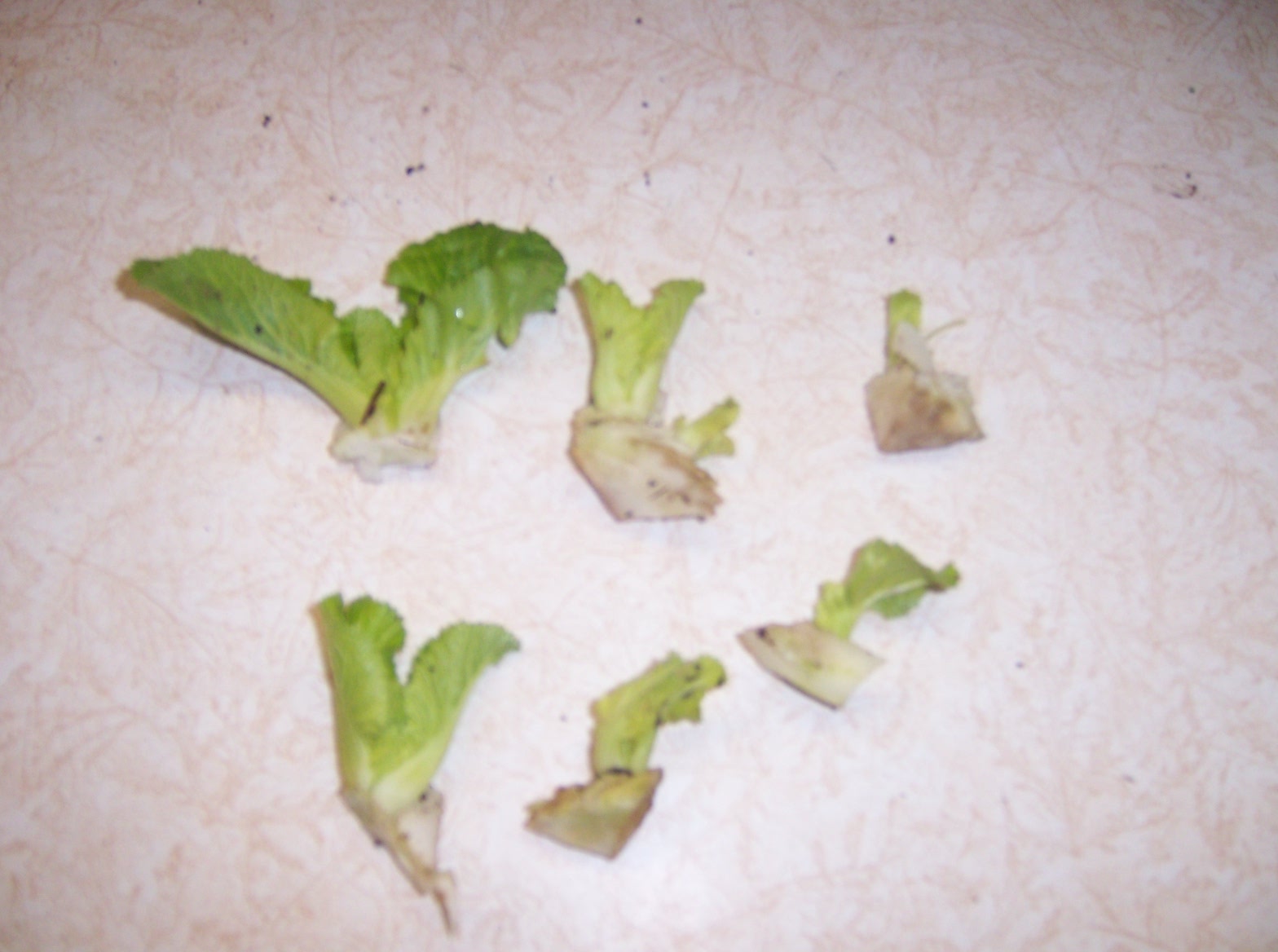
   This time I dug it up and to it home to perform surgery.  It had sprouted six little plantlets that I cut away with a little bit of the stem included. 

Chinese Cabbage plantlets, 12/4/11

Planted in straight compost, 12/4/11

      And now I am going to pot the stump and put it on the porch for the winter to see if it puts out any more little babies.  Maybe the saga will continue.  A further part to the experiment was to take the leaf stems in the above pictures, and cut them into one to two inch pieces.

Chinese Cabbage stem pieces, 12/4/11

      These were planted in straight compost, some laying on top of the compost, some covered by compost, and some standing up in the compost.  All are in covered containers to maintain high humidity.  I expect, or at least hope, that many of the pieces will develop little plants attached.  Which I can then pot out for early additions to the cold frames.
      I found this article to be helpful: 

and this one too:
                     http://www.ehow.com/how_7842272_clone-vegetable-plants.html

      I would love to hear about any vegetables that you may have started as clones or cuttings.