Showing posts with label Shasta Daisy. Show all posts

Friday, May 24, 2013

Back Yard Garden, May 22, 2013

Back Yard,  May 22nd, 2013
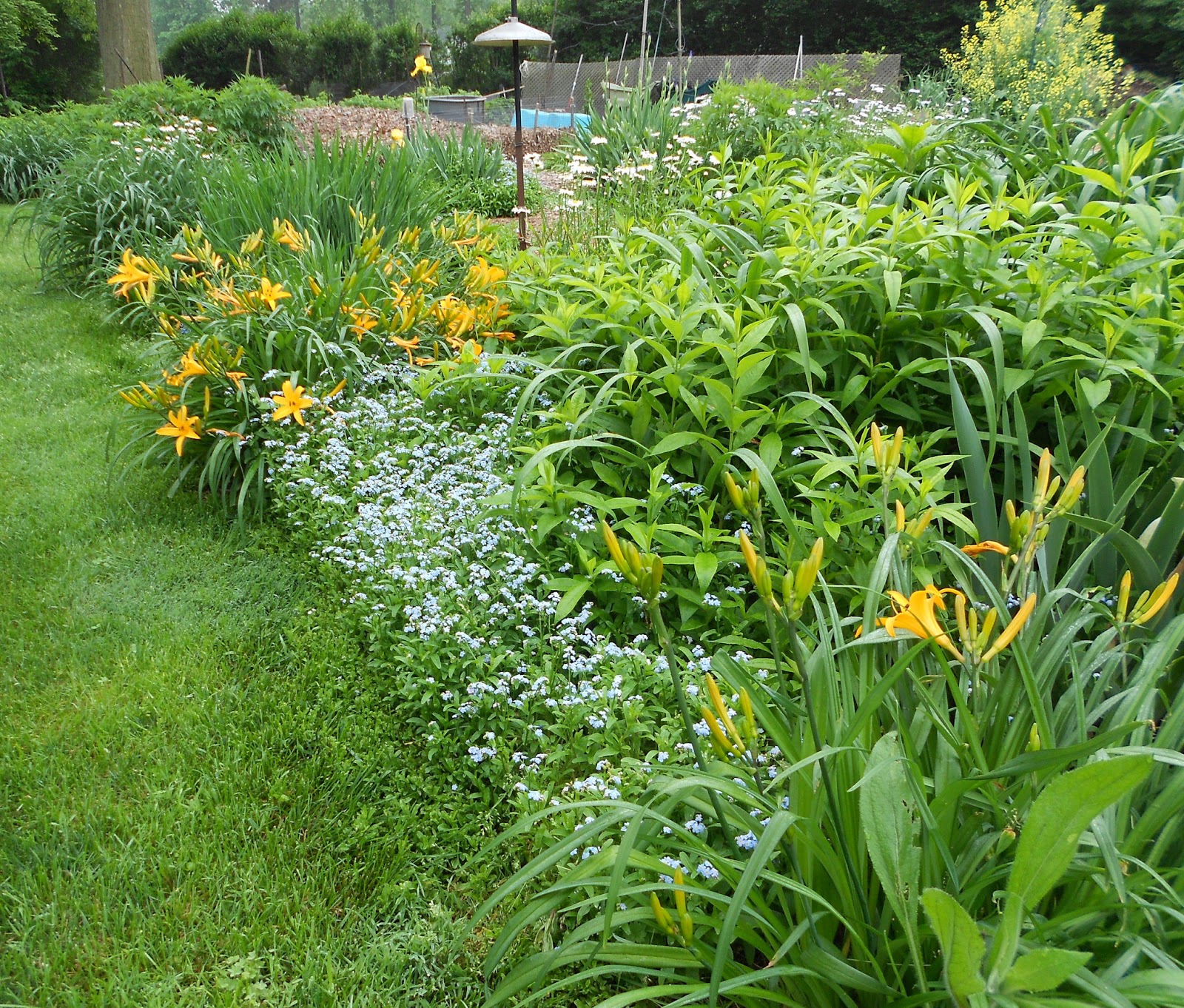
      One part of the garden is very much in bloom right now.  Most of these plants were available in the recent plant give away.  That is mostly finished for now as prime transplanting time has come and gone.  During the give away time I found it difficult to remember the colors of some of the day lilies, so I can identify the Stella de Oro lilies that are now blooming.


      The clump of Stella de Oro in the foreground are in the northeast corner of the back garden.  A strip of Forget Me Not runs up to the next clump of lilies.  The taller stems behind the Forget Me Not are phlox which are not yet in bloom.


     Walking around into the garden leaves the one Stella clump in the middle behind the bird feeder, while the second clump is now hidden by the orange tetraploid lilies that are taller, but not yet in bloom.  The pure yellow iris at the right is just starting to bloom, and the iris in the middle forefront is a pure blue just about to bloom.


      This is the same yellow iris, but this shot swings a little to the left and shows the shasta Daisies in the middle.  On the right are the tetraploid lilies again, and the magenta colored clematis is at the top in the middle.


      This shot shows the magenta clematis in the foreground, and the purple clematis in the middle.  The purple has lots of baby offshoots at its base.  They were and still are available for the asking.  At the base of the magenta clematis, the Joe Pye Weed is just starting to grow.  It needs to be dug out REAL SOON and a limited quantity might be available for a road trip.


      The perennial geranium is near the entry to this back yard garden.  To the right of the geranium is the African Daisy, about three feet tall on its way to six feet tall in a couple of weeks.  The gold finches will feast on the daisy seeds later in the season.  It won't be long before the Shasta Daises seen earlier are finished blooming and become finch bait.  There are some Forget Me Not behind the geranium, and behind that is penstemon, also known as Beard's Tongue.

A different angle, May 22nd,  2013

      This mixed purple and blue Bearded Iris is by the deck in back.  It is my favorite of my iris, and has had a very nice bloom this year.  I will move some this fall to see if I can increase my stock.


      The Weigela is now in full bloom.  My wife was told that if we prune it back hard after blooming, there will be a second flush of color later in the year.  As it badly needs a trim, we will put that theory to the test.
      What a pretty time of year.  And there has been enough cool weather this spring to prolong the colors!

Monday, May 21, 2012

Mid May Blooms

Siberian Iris,  5/18/2012
      I can't recall exactly how long we have had our Siberian Iris, but I suspect it is better than twenty years.  And it is still a treat to see the blooms every year.  It is extremely hardy, borders on being invasive, and may require major digging efforts to remove.  Yet, I recommend it.  In fact, a few year's ago we shared some with our daughter.  Her husband has separated clumps, then separated them again.  Their results:

Butterfly Bed,  5/19/2012

Rob's Island Bed,  5/19/2012
      A little can go a long way.  He has been moving clumps to his school to soften the barren landscape.  It will be there a long time from now.

My back garden,  5/18/2012
      This shot is of the back yard garden.  The bearded Iris are on their way out, as the Siberian Iris are on their way in.  The light blue ground cover "Forget Me Not" is in prime blooming mode.  The somewhat darker purple at the middle left is Veronica.  This bed is still over crowded, so many of these plants are still available for road trips.

Shasta Daisies,  5/18/2012
      The Shasta Daisies are also in full bloom.  A big clump of daisies is such a soothing sight for me.  They are so tall now that a big rain will knock them over.  They self seed with abandon.

Bletilla,  5/18/2012
      The Bletilla, is a temperate, terrestrial genus of orchids containing nine species.  Mine have survived here for maybe twenty years, though they have not multiplied.  I need to move mine as they are under the weigela which blooms at the same time and has a similarly colored flower.  Yet I am afraid to move them because they have been happy in this location.  The white "Alba" variety that I had is long gone.

Saint John's Wort,  5/18/2012
      The Saint John's Wort was a volunteer that popped up next to the porch.  It had such a pretty leaf that we left the plant to grow.  It rewarded us with these beautiful little yellow flowers, and went on to multiply slowly.  We transplanted some babies to the difficult area under the maple tree.  They have thrived there, and continue to spread slowly as a low bush ground cover.

Mock Orange,  5/18/2012
      The mock orange is another shrub that has self seeded successfully under the maple tree.  This year has seen a very prolific season of bloom.

Mock Orange
Amaryllis,  5/20/2012
      This amaryllis has been with us for a long time, multiplying from one bulb to six.  I have another pot of the same flower, so I must have divided it at sometime in this past.  Obviously it needs dividing again.  It overwinters on the porch, where the temperature gets to a minimum of 42 degrees.  It is not watered at all over the winter, yet in the spring sends up new growth signalling the start of the watering for the new year.

And that makes it happy

Saturday, April 21, 2012

Plant Give Away, Too

To add to the plant give away post:


Shasta Daisy,  5/13/2011
      These daisies are probably Shasta daisies, and are right now coming into bloom from the warm spring weather this year.  Enjoys lots of sun.  They self seed freely, and the seed heads are enjoyed by gold finches.  Still lots of clumps at this writing.


Purple Columbine,  5/13/2011
      The purple columbine self seeds, and will pop up in lots of new places.  Does well in partial shade and likes moisture.  I now have some plants that are basically white.  Limited supply of columbine at this writing.


My back yard garden,  7/7/2011
      This shot shows lots of plants that are available.  The tall plants in the background are African daisies.  They grow to six feet by July, and the seed heads are adored by gold finches.  The day lily in the middle of the shot is a solid orange tetraploid.  The clump does spread fairly rapidly, but can be controlled easily by digging out plants to give away.  The lily on the right is a dark magenta color, and the lily in the front is a combination yellow and orange.  Also have some shorter Stella De Oro daisies, a nice compact yellow.


Canna Lily,  7/7/2011

      The cannas have not yet started to grow, but will be six to eight feet tall by July.  This particular variety has a fairly insignificant red flower spike for such a large canna.  Yet it is visited often by our hummingbirds, so I have not switched it out for a showier variety.  I probably have some lambs ear that is in the right foreground.  Interesting leaves, not much on the flowers.  I do have some rose campion available, which has similar leaves to the lamb's ear, but the campion has strikingly beautiful flowers.  The garlic behind the campion is a hard neck variety that is showing the garlic scapes.  We still have beautiful garlic bulbs from last years harvest.  No way that those are available. 


White and Pink Phlox,  July 2011


       The phlox was pretty, but reserved when grown in a fairly shady spot under a maple tree.  When moved to the back garden, it had an explosion of self seeding.  Plenty available.


Black eyed Susan and African Daisies,  July 2011
      Black eyed Susan are in the foreground, with the taller African daisies behind.  The black eyed Susan is particularly drought resistant, and its seed heads are eaten by the finches.
      These are the pictures I could find this morning.  Lots of other things are available, but not yet listed.